
How AI Is Changing the Way Public Adjusters Handle Claims
Artificial intelligence is not a future development in the insurance claims space. It is already here, already deployed, and already influencing outcomes — most often on the carrier side, and most often in ways that are invisible to policyholders.
Understanding what AI is doing in this industry isn't just intellectually interesting for public adjusters. It's a competitive necessity. The carriers you negotiate with are using AI to process documents, assess damage, flag claims for scrutiny, and generate the low initial estimates you're pushing back against. Knowing what tools they're running — and what AI can do for your side of the table — changes how you approach the work.
This post covers what AI is actually doing in property insurance claims today, where it creates risk for policyholders, where it creates opportunity for public adjusters, and how purpose-built AI tools are beginning to change practice operations at the firm level.
What Carriers Are Already Using AI to Do
The scale of AI adoption on the carrier side is larger than most public adjusters realize. A survey by the National Association of Insurance Commissioners found that 70% of home insurers either use or plan to use AI or machine learning systems in their operations. On the auto side, that number climbs to 88%.
What are they using it for? The applications span the entire claims lifecycle.
Aerial and satellite imagery analysis. Carriers are using AI-powered computer vision to analyze drone footage, satellite imagery, and aerial photography to assess roof and structural damage — often before a human adjuster ever sets foot on the property. These systems can flag damaged shingles, identify water pooling, and estimate repair scope from images alone. The efficiency gains are real. So is the potential for undercounting damage that requires on-the-ground inspection to identify properly.
Document processing and extraction. AI systems read incoming claim documents — estimates, repair invoices, contractor bids, adjuster notes — and extract key data points automatically. What used to take a staff adjuster hours of manual review can now be processed in minutes. This accelerates claim handling, but it also means the initial scope the carrier is working from may be AI-generated, not the product of a thoughtful human review.
Predictive severity scoring. Carriers use machine learning models to score incoming claims for predicted complexity, cost, and litigation likelihood. High-scoring claims get routed to more experienced adjusters or flagged for enhanced scrutiny. Low-scoring claims may be fast-tracked toward automated settlement. If your client's legitimate and significant claim gets scored as low-complexity, the resulting estimate will reflect that misclassification.
Settlement range generation. Generative AI models are being deployed to analyze all available claim data and generate a recommended settlement range — before negotiation begins. That recommendation shapes the adjuster's opening position. Public adjusters who understand this dynamic know they're not just negotiating against a human adjuster's judgment. They're sometimes negotiating against a model's output that the human adjuster is anchored to.
AI-assisted claim denials. This is the development drawing the most attention in Florida's current legislative session, and for good reason. Some carriers have been using AI systems to generate denial recommendations with minimal or no meaningful human review. Florida's HB 527, currently advancing through the legislature, would explicitly prohibit AI systems from serving as the sole basis for denying or reducing a claim — requiring a qualified human professional to make that decision independently.
Where This Creates Risk for Policyholders — and Opportunity for Public Adjusters
The efficiency gains from AI adoption don't distribute equally. Carriers benefit from faster processing and reduced loss-adjustment expenses. Policyholders benefit from faster simple claims — and face new risks on complex ones.
The undescoped initial estimate problem. When AI systems generate damage assessments from aerial imagery or brief documentation, they are working from limited inputs. Hidden damage — moisture behind walls, structural compromise beneath surface damage, code-upgrade requirements — doesn't show up in satellite photos. The AI generates a scope based on what it can see. A public adjuster who physically inspects the property sees what the system missed. That gap between the AI-generated scope and the actual scope is recoverable depreciation, missed line items, and supplement potential.
The anchoring problem. When a carrier adjuster presents their initial estimate, that number anchors the negotiation — even when it's wrong. If the initial estimate was generated or heavily influenced by an AI system trained to recommend conservative figures, it takes well-documented evidence to move it. Public adjusters who understand this enter negotiations with comprehensive documentation, not just a counter-estimate.
The speed pressure problem. AI-accelerated claims processing creates implicit pressure on policyholders to respond and decide quickly. Automated systems send notifications, generate settlement offers, and set short response windows. Policyholders without representation may feel pressure to accept before fully understanding what they're entitled to. A public adjuster who understands carrier systems can recognize these tactics and protect their clients' time to respond appropriately.
What AI Can Do for Public Adjusters
The same category of tools reshaping the carrier side is now becoming available to public adjusters — and the leverage is significant for a profession that has historically operated with strong subject matter expertise but limited operational technology.
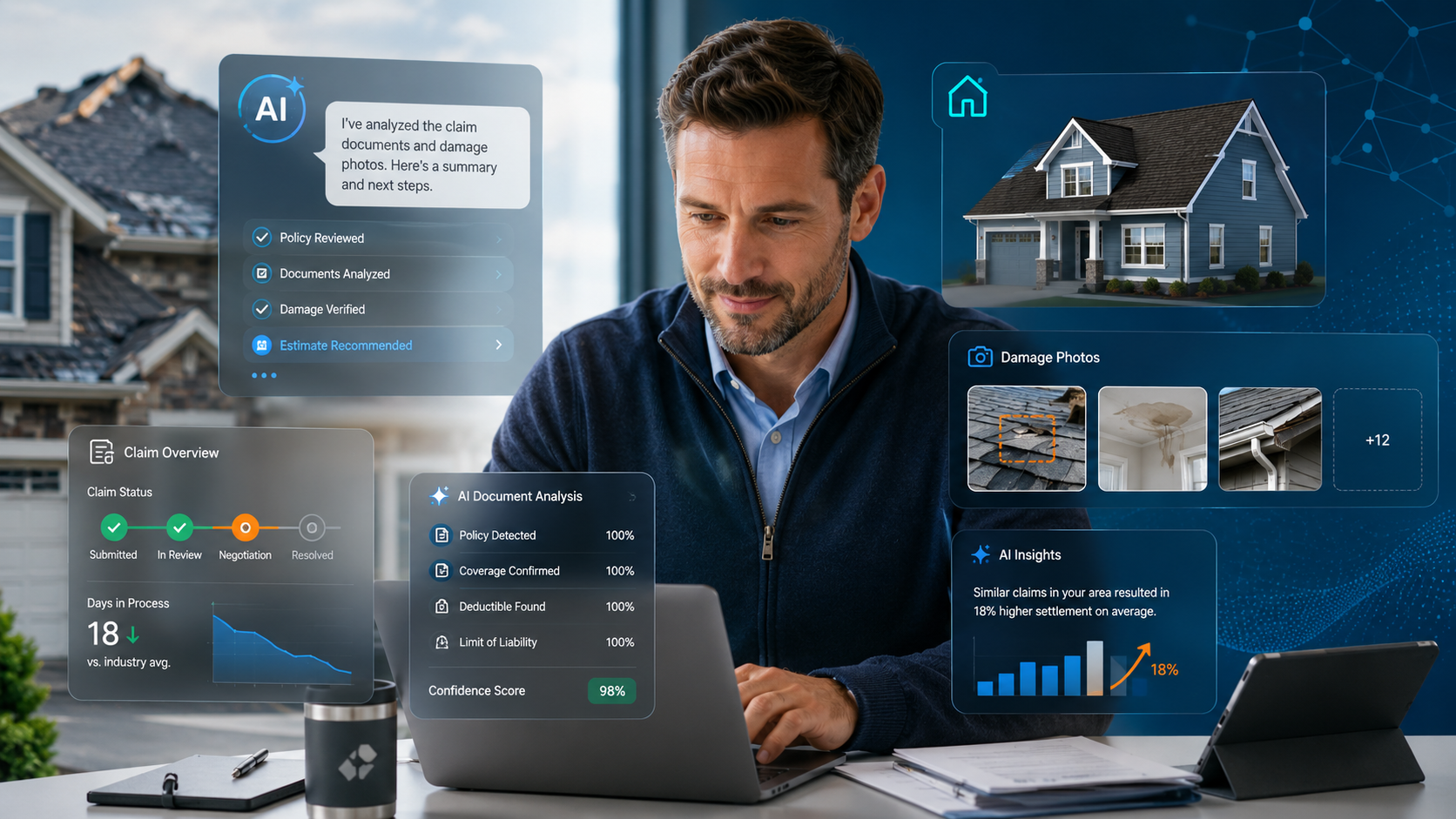
Document recognition and extraction. Processing a complete insurance policy, a carrier estimate, a contractor invoice, and a prior claim file is time-intensive work that AI can dramatically accelerate. AI document recognition can extract key provisions, identify coverage limits and exclusions, flag inconsistencies between documents, and surface the specific policy language relevant to a dispute — in a fraction of the time manual review requires.
Policy analysis assistance. Insurance policies are dense legal documents that vary significantly by carrier, form type, and endorsement. An AI assistant trained on insurance policy language can help surface relevant provisions, identify applicable endorsements, and flag exclusions that may not apply given the specific loss circumstances. This doesn't replace adjuster judgment — it accelerates the information-gathering that judgment depends on.
Supplement and rebuttal drafting. Generative AI can accelerate the drafting of supplement narratives, coverage position letters, and carrier rebuttal documents. The adjuster provides the facts, the policy citations, and the strategic framing. The AI drafts the document. The adjuster reviews, edits, and sends. What used to take two hours of writing can take thirty minutes. Across a caseload of twenty active claims, that time savings is meaningful.
Pattern recognition across claims. For firms managing significant claim volume, AI tools can surface patterns across the portfolio — which carriers are consistently slow to respond, which loss types have the longest settlement timelines, which claim stages are most likely to stall. This is business intelligence that previously required someone to build and maintain manually.
Client communication drafting. Status update emails, document request follow-ups, settlement explanation letters — the administrative communication load of a public adjusting practice is substantial. AI can draft these communications from claim data, freeing adjuster time for the work that requires their expertise.
The Human Element Isn't Going Away
Here's the honest counterpoint to all of this: AI tools in claims adjusting are assistants, not replacements for professional judgment.
The physical inspection that identifies hidden moisture damage is a human skill. The negotiation that moves a carrier adjuster off a low initial estimate requires interpersonal judgment and professional credibility. The policy analysis that identifies a coverage argument the carrier missed requires someone who understands both the legal language and the physical facts. The relationship with the client, sustained over what can be a months-long process, is a human relationship.
What AI changes is the efficiency with which the administrative and analytical work surrounding those human judgment moments gets done. Public adjusters who use AI tools well arrive at those moments better prepared, more thoroughly documented, and less burdened by work that didn't require their expertise.
The adjusters who ignore these tools don't protect their professional relevance — they just spend more time on work that could be faster.
AI at Claim Mosaic
Claim Mosaic's Enterprise tier includes Mosaic AI — a suite of AI-powered tools built specifically for the public adjusting workflow. This includes AI Document Recognition for rapid processing of policies, estimates, and claim documents, and an AI Assistant that supports policy analysis, correspondence drafting, and claim research.
These tools are designed to augment experienced adjuster judgment, not replace it. Every AI output in Mosaic is adjuster-reviewed before it becomes part of the claim record. The human is always in the loop — and always in control.
For firms evaluating where AI fits in their practice, the right starting point is identifying the specific tasks that consume the most time without requiring the most expertise. That's where AI delivers the fastest return.
Claim Mosaic's AI features are available on the Enterprise tier. Not ready for Enterprise? Start with Simple or Professional and upgrade when you're ready. Start a free 14-day trial at claimmosaic.com →