
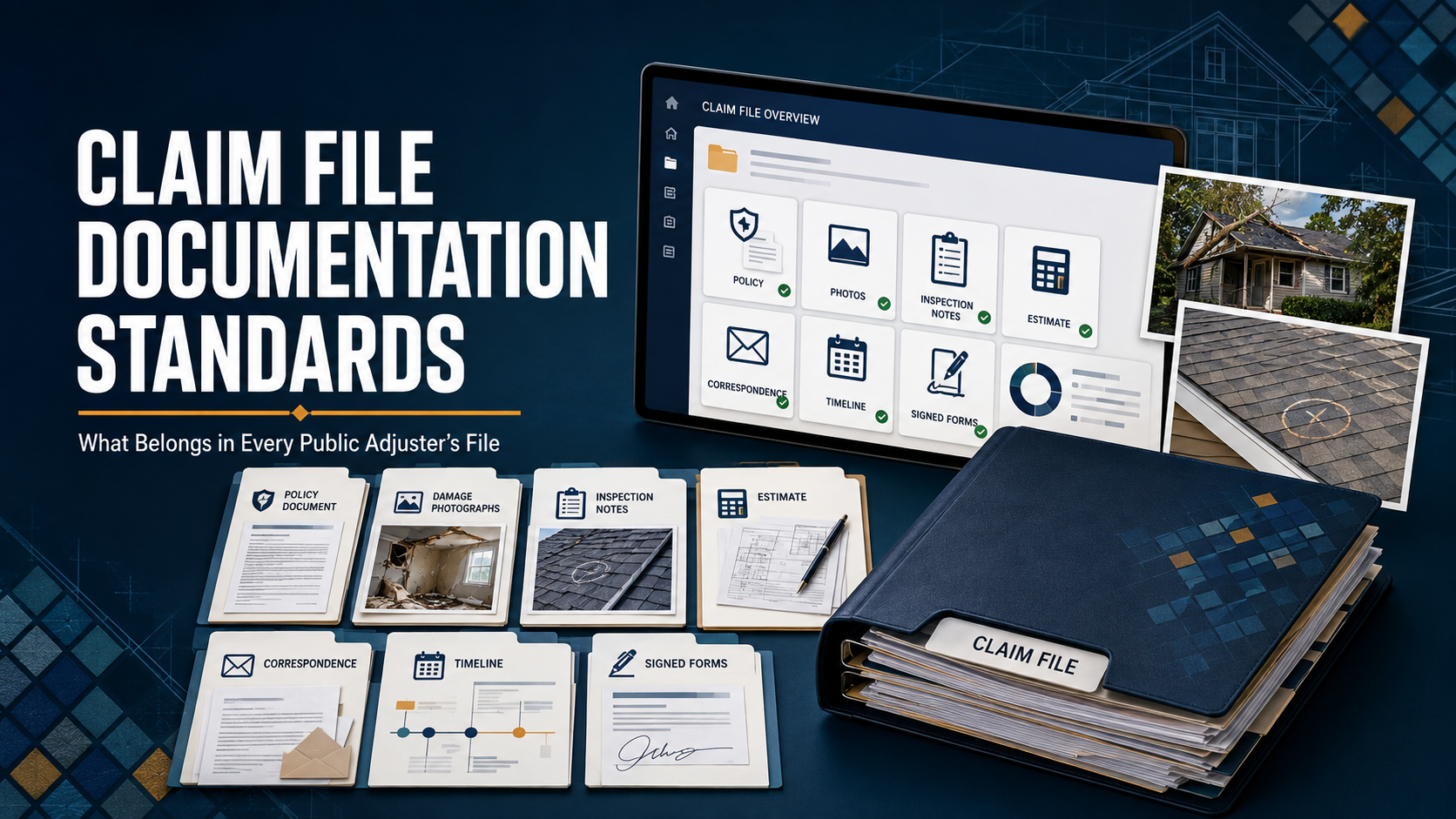
Claim File Documentation Standards: What Belongs in Every Public Adjuster's File
What belongs in a public adjuster's claim file?
Quick answer: A complete public adjuster claim file contains six components: signed authority documents, the full policy and declarations, dated loss documentation, every version of the estimate, a contemporaneous correspondence and activity log, and a payment ledger. Each item should be named consistently, dated, stored in one system of record rather than across email and phones, and retained for the period your state requires — five years after the adjustment is complete in Florida.
Most firms don't have a documentation problem on the day of inspection. They have one eighteen months later, when a file has to answer for itself and nobody can remember what happened.
The photos are on a phone that left with a former adjuster. The estimate exists in four versions and nobody's sure which one went to the carrier. There's a phone call everyone remembers but nobody logged. The file was fine while it was moving. It fell apart the moment it had to stand still and be examined.
A documentation standard is what prevents that. Not a folder full of everything — a defined structure that every file in your firm follows, so any file can be picked up cold and understood by someone who wasn't there.
The three tests every file has to pass
Before getting into components, it's worth being clear about who a claim file is actually built for. It isn't built for the adjuster who handled it. That person already knows what happened. A file is built for three readers who don't:
The successor test. If the adjuster who opened this file left the firm tomorrow, could someone else take it over from the file alone, without a phone call? This is the everyday test and the one most files fail. It's also the one with the most direct business consequence — every handoff that requires reconstruction is billable time spent producing nothing.
The dispute test. If this claim goes to appraisal, mediation, or litigation, does the file show a clean, dated sequence of what was inspected, what was documented, what was submitted, and when? Not conclusions — sequence. A file that can't establish chronology can't support anything built on top of it.
The audit test. If a regulator or your E&O carrier asks for this file, is everything there, and can you produce it quickly? This one is binary. Either the record exists or it doesn't.
A file that passes all three is a complete file. Everything below is in service of that.
The six components of a complete claim file
1. Authority documents
The signed contract or agreement, any letter of representation, and the record of when it was transmitted to the carrier. This is the first thing anyone examining your file will look for and the easiest thing to have wrong — an unsigned page, a missing date, a version that doesn't match what the client actually received.
Store the executed copy, not the template. If the agreement was amended or the scope of representation changed, both versions belong in the file with dates.
2. Policy documentation
The declarations page, the full policy form with all endorsements, and the record of how and when you obtained it. If you requested a certified copy from the carrier, the request and the response both belong in the file.
The reason to keep the request, not just the policy, is that a documented request establishes a date. Files that contain only the policy can't show when the firm came into possession of it.
3. Loss documentation
Photographs, measurements, moisture readings, inspection notes, and any third-party reports. Three rules make this component usable rather than merely voluminous:
- Every image needs a date and a location. An untethered photo of damaged sheathing proves almost nothing. The same photo with a date, an elevation, and a room reference is evidence.
- Photograph the negative space too. Undamaged areas, overview shots, and address confirmation shots establish context and scope boundaries. Firms consistently over-document damage and under-document the surrounding condition.
- Capture on a device that syncs to the file, not to a person. Photos that live in a personal camera roll are not in your file. They are in someone's phone, and phones leave.
4. Estimate versions
Every estimate that existed, in order, with dates and a note on what changed. Not just the current one.
Firms tend to overwrite. It feels tidy and it destroys the record. When a carrier asks why a number moved, or an appraiser asks what was in the original scope, "we revised it" is not an answer. A dated series is.
5. The correspondence and activity log
This is the component that separates organized firms from busy ones. Every substantive contact — call, email, text, site visit, voicemail — logged with date, participants, and a one-line summary of what was said or agreed.
The critical word is contemporaneous. A note written the day it happened is a record. A note reconstructed six months later from memory is a recollection, and it carries a fraction of the weight. The habit that matters is logging at the moment, not at the end of the week.
Two practical failure modes worth naming: correspondence that lives only in individual inboxes, and text messages on personal phones. Both are extremely common and both mean your firm does not actually possess its own file.
6. The payment ledger
Every payment issued, with date, amount, and what it was applied to — ACV, recoverable depreciation, supplemental payment, deductible treatment, fee. This is where clients most often ask questions you have to answer precisely, and where reconstructing after the fact is genuinely painful. We've written separately about tracking ACV and RCV payments across the claim lifecycle.
A quick reference
Component | Why it exists | Common failure |
|---|---|---|
Authority documents | Establishes representation and its date | Unsigned or undated copy on file |
Policy and endorsements | Establishes what was reviewed and when | Policy present, request record missing |
Loss documentation | Establishes condition and scope | Photos on personal devices, no dates |
Estimate versions | Establishes how the position developed | Overwritten instead of versioned |
Activity log | Establishes the chronology | Written from memory, weeks late |
Payment ledger | Establishes what was received and applied | Tracked in a separate spreadsheet |
Conventions that make the standard actually work
A standard nobody follows is a document, not a system. Three conventions do most of the work:
Date-first file naming. 2026-08-18-carrier-estimate-v2.pdf sorts chronologically on its own and tells you what it is without opening it. Pick a format, write it down, and require it. Any consistent convention beats the best convention applied inconsistently.
One system of record. The single highest-leverage decision a firm makes about documentation isn't a naming convention — it's that there is exactly one place a claim lives. The moment documentation is split between a drive, an inbox, a spreadsheet, and someone's phone, the complete file exists nowhere. This is the structural reason spreadsheet-and-folder setups eventually break as a firm adds files and people.
A closing checklist. Before a claim is marked closed, someone confirms all six components are present and complete. Two minutes at close saves hours at retrieval, and it's the only reliable point at which gaps get caught while they're still fixable.
Retention: how long you have to keep it
Retention is a state-law question and the answer varies, so check the rule in every state where you hold a license.
In Florida, adjusters are required to maintain their records for a particular claim or loss at their place of business for at least five years after the adjustment is complete, under §626.875, Florida Statutes. Florida's public adjuster conduct rule (Rule 69B-220.051, F.A.C.) carries related recordkeeping expectations, including on itemized estimates.
Two practical implications firms miss. First, the clock starts at completion of the adjustment, not at the date of loss — a long claim has a long tail. Second, "retained" means retrievable. A backup you can't search inside a reasonable window is not meaningfully a record.
Where firms actually lose the thread
Almost no firm decides to document badly. The gaps come from predictable places:
- The busy season. Documentation discipline is the first thing to go when volume spikes, and catastrophe files are exactly the ones most likely to end up in dispute.
- Turnover. Every departure takes undocumented context with it. The size of that loss is a direct function of how much lived in someone's head instead of the file.
- The verbal agreement. A call where something meaningful was agreed, never logged, is the single most common gap in otherwise clean files.
- The assumption that tools solve it. Software makes a standard enforceable and searchable. It doesn't create one. The standard is a decision the firm makes; the system is what keeps it from eroding.
That last point is worth sitting with, particularly as AI tools take on more of the claims workflow. Automation applied to a disorganized file produces faster disorganization. The documentation standard has to come first.
Start with one file
Don't roll out a firm-wide standard in a single week. Take one active claim, build it to the six-component structure, and see what's missing. That gap list is your actual standard — the specific things your firm doesn't currently capture. Write those down, apply them to new files going forward, and clean up existing files at their next natural touchpoint.
The firms with strong documentation aren't more diligent than everyone else. They just made the structure explicit once, put it somewhere it gets enforced, and stopped relying on memory.
Claim Mosaic is claims management software built specifically for public adjusting firms — documents, photos, notes, correspondence, estimates, and payments in one record per claim, so the complete file exists in one place by default. Explore the features or start a free trial.
Frequently asked questions
What documents should be in a public adjuster's claim file? Six components: signed authority documents, the full policy with endorsements, dated loss documentation and photographs, every version of the estimate, a contemporaneous correspondence and activity log, and a payment ledger.
How long must a public adjuster keep claim records? It varies by state. In Florida, records relating to a particular claim or loss must be retained at the adjuster's place of business for at least five years after the adjustment is completed under §626.875, Florida Statutes.
Why do claim file notes need to be contemporaneous? A note written at the time of the event is a record of what happened; one reconstructed months later is a recollection. Contemporaneous entries establish an unbroken chronology, which is what makes a file usable in appraisal, litigation, or an audit.
What is the best way to organize claim photos? Date and locate every image, capture undamaged areas and overviews alongside damage, and shoot on a device that syncs directly to the claim record rather than to an individual's personal camera roll.
Does claims software replace a documentation standard? No. Software enforces and preserves a standard but does not create one. The firm decides what a complete file contains; the system keeps that definition from eroding under volume and turnover.